

.png)
The real cost of incomplete data
Let's talk numbers. If you're spending €5,000 per month on advertising and losing 40% of your tracking data, you're essentially flying blind on €2,000 of spend. You don't know:
- Which ads actually drive sales
- What your real return on ad spend (ROAS) is
- Which audiences are worth investing more in
- Where to cut budget without hurting results
This isn't theoretical. We've seen businesses discover their "worst performing" campaign was actually profitable once they implemented proper tracking. They were just missing the data.
Client-side vs server-side: what's actually happening?
The old way: client-side tracking
Here's what happens with traditional tracking:
- Someone clicks your ad and lands on your website
- Their browser tries to load tracking scripts (Facebook Pixel, Google Analytics, etc.)
- Ad blocker sees these scripts and blocks them
- Your analytics tools never receive the data
- You think the user didn't convert (but they actually did)
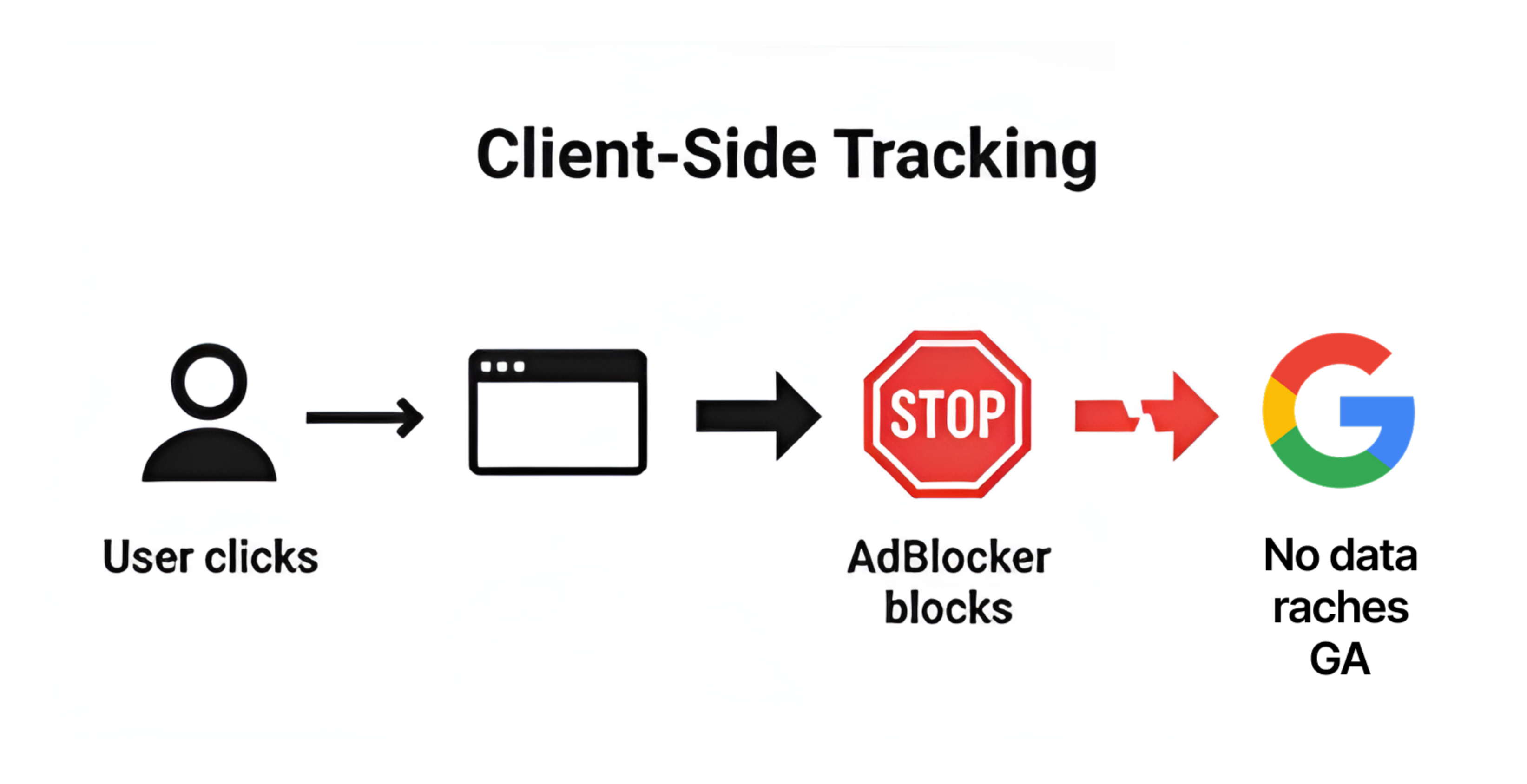
Over 40% of users might be invisible to you. That's not a small margin of error - that's a massive blind spot in your business intelligence.
The new way: server-side tracking
With server-side tracking:
- Someone clicks your ad and lands on your website
- Data is sent to YOUR server (not directly to Facebook/Google)
- Your server processes the data and sends it to analytics tools
- Ad blockers can't see what's happening on your server
- You get the full picture

The magic? Because the server is in your domain, browsers and ad blockers treat it as a normal part of your website. No blocking, no data loss.
What you gain with server-side tracking
1. Make smarter budget decisions
When you see the complete picture:
- You know which campaigns actually work
- You can confidently increase budget on winners
- You stop wasting money on campaigns that look bad but might be profitable
- Your ROAS calculations are actually accurate
Real example: One of our clients was about to shut down a Google Ads campaign that showed 1.5x ROAS. After implementing server-side tracking, the real ROAS was 3.2x. They would have killed a profitable campaign based on incomplete data.
2. Faster website = more sales
Every tracking script running in the browser slows down your site. And speed matters - studies consistently show that even a one-second delay can cost you 7% in conversions.
Server-side tracking moves the heavy lifting to your server:
- Pages load faster
- Users don't wait
- More people complete checkout
For an ecommerce site doing €50,000 monthly, that 7% could be €3,500 in recovered revenue. Every. Single. Month.
3. Stay compliant with data privacy laws
GDPR, CCPA, and other privacy regulations aren't going away - they're getting stricter. With server-side tracking, you control:
- What data you collect
- How long you keep it
- Who gets access to it
- What information gets filtered out
You can strip out sensitive information (email addresses, phone numbers) before sending data to advertising platforms. This isn't just compliance - it's good business practice.
4. Better quality data
Your server can:
- Verify that orders are real (not bots or fraud)
- Add context to conversions (customer lifetime value, subscription tier)
- Filter out test orders and employee activity
- Connect online and offline data
This means cleaner reports and better insights. You're not just getting more data - you're getting better data.
The honest truth: what server-side tracking costs
Let's be real: server-side tracking isn't free, and it's not simple. Here's what you need to know.
1. Monthly costs
You'll need to pay for:
- Server hosting (starting around $50-100/month for most businesses)
- Setup and configuration (one-time cost, typically $500-2000 depending on complexity)
- Ongoing maintenance (either in-house time or agency retainer)
For a business spending $5,000+/month on advertising, this is usually a no-brainer ROI. For smaller budgets, you need to do the math.
2. Technical complexity
This isn't something you set up yourself over a weekend. You need someone who understands:
- How tracking works
- Server configuration
- Your analytics setup
- Privacy regulations
Most businesses work with an agency (hi! 👋) or have an in-house technical marketer handle it. DIY is possible but risky if you get it wrong.
3. Maintenance is ongoing
Every new campaign, every new tracking event, every platform update - someone needs to maintain the server-side setup. It's not set-it-and-forget-it.
Think of it like hiring a bookkeeper. Yes, it costs money. But the alternative (messy books or missing data) costs you more.
How to actually implement server-side tracking
You have three main options:
Option 1: Google Tag Manager Server-Side (DIY)
Google provides a free tool (Google Tag Manager Server-Side), but you need to host it yourself on Google Cloud.
Good for:
- Businesses with technical resources
- Those who want maximum control
- Companies already using Google's ecosystem
Not good for:
- Non-technical business owners
- Small teams without dev support
Option 2: Managed platforms (like Stape)
Platforms like Stape handle the technical complexity for you. You get a dashboard, they manage the servers.
Good for:
- Businesses that want it done right without learning server management
- Growing companies scaling advertising spend
- Teams focused on results, not infrastructure
Not good for:
- Very small businesses (cost might not justify benefits yet)
- Those needing heavy customization
Option 3: Platform-specific gateways
Some advertising platforms offer their own server-side solutions. Facebook has Meta Conversions API Gateway, similar tools exist for TikTok, Snapchat, etc.
Good for:
- Businesses using just one or two advertising platforms
- Quick implementation
- Testing server-side tracking before full commitment
Not good for:
- Multi-channel businesses (costs add up)
- Those needing unified tracking across platforms
Should your business invest in server-side tracking?
Here's the honest decision framework:
You should definitely consider it if:
- You're spending €
3,000+ monthly on digital advertising
- You run an ecommerce store with regular transactions
- You're in a competitive market where data accuracy matters
- You've noticed declining tracking accuracy (iOS updates, cookie restrictions)
- You're scaling and need reliable data to guide decisions
- You care about GDPR compliance and data privacy
You can probably wait if:
- Your advertising budget is under €1,000/month
- You're just starting out with digital marketing
- You don't have technical support available
- Your current tracking seems accurate enough for decision-making
- You're testing business viability before investing in infrastructure
The ROI calculation
Simple math: If server-side tracking costs you €150/month and recovers even 10% of your €5,000 ad spend's visibility, you're seeing data on an additional €500 of spend. If that helps you make one better budget decision per month, it pays for itself many times over.
A bit of tracking history
Fun fact: In the 1990s and early 2000s, all analytics were performed on the server side. Every user request generated a server call that was logged in access files. These logs were then downloaded and parsed by analytics tools to generate reports.
Almost 30 years later, history has come full circle, and we are once again talking about server-side tracking.
But this time it's different. We're combining the speed and interactivity of modern web with the control and accuracy of server-side processing. It's evolution, not regression.
What to do next
Server-side tracking is becoming less of a "nice to have" and more of a necessity for serious online businesses. Privacy regulations are getting stricter, browsers are blocking more tracking, and ad costs are rising. The businesses that succeed will be those making decisions based on complete data.
If you're spending serious money on advertising and want to make sure every euro is working for you, it's time to consider server-side tracking.
Not sure if server-side tracking is right for your business? Book a free consultation with our team. We'll look at your current setup, advertising spend, and business goals to give you an honest recommendation.
Want to learn more about making your marketing more effective? Check out these articles:
